Saturday, February 29, 2020

Giving Up or Giving In? Read This First

I have run up on so many sandbars and shorelines in my life that they disappear into a generalized swooshing noise, with little to no specificity. The sound of a canoe bottom on sand, or gravel, silt or rocky shoreline is the end of just one leg of our trip. Occasionally we make these stops on purpose, occasionally they take us away from our perceived plans, we hit a submerged rock or log by mistake. It currently feels like our entire culture has been reset, a sort of hard stop to progress. There are dangerous eddy currents all around and we are hopelessly stranded upon a hidden impediment in the river of life. The reason I use the analogy of a canoe trip is quite possibly because we are all buoyed by our hopes, our dreams, our desires upon an amalgam of fears and anxieties, difficulties and problems that are frequently of our own making. As we look around we also see and hear about very real and existential threats to the very existence of our species. Rather than being only the domain of philosophers and Malthusians, even our children are learning of the sixth mass extinction and it is only a small step from understanding of this to utter nihilism. We must always remember that to stay afloat, we need to keep the weight of our burden under the displacement potential of our vessel.

If and when nothing matters, we are prone to surrender in the face of even the slightest impediment. I often wonder at the seemingly endless hours people will spend, literally twiddling their thumbs, "working" on their phones to play games, create digital landscapes, experience life vicariously through social media and "win" imaginary wars that result from billions of micro processing switches flip flopping between their two states, on and off. Yes, or no. In very real ways, I'm doing that now although I am also encoding a clear message about actual events, I do post these messages in the digital realm. The digital electron flux that allows me to reach around the world into your consciousness is the same one that some people escape to when they do crossword puzzles, create dynamic landscapes upon which to build imaginary kingdoms or "win" at Tetris. We can choose to either escape into the digi-realm, letting it use us or use it to further civilization or honor the humanity of other participants in this new landscape. I have chosen to honor you.

The canoe analogy was probably bolstered this week by a funny joke I heard during a conversation between Stephen Clobert during a digitally recorded conversation with Elizabeth Warren. You see, there is a now legendary concept here in the good old U.S. of A. that people want to vote for someone they would "like to have a beer with." This very idea is curious when you also want to keep alive the fiction that we are a prudish and Puritan nation. Puritans abhorred alcohol, realizing that it interfered with articulate thought and expression. But that is a discussion I will delve into later. It an effort to humanize Elizabeth Warren, one of the Democratic candidates for President, Stephen Colbert had a couple drinks with her. His preferred spirit and then a beer of her choosing. When she selected Michelob Ultra, Stephen was compelled to ask if she knew how making love in a canoe was like her beer of choice. The answer, "They are both fucking near water.", brought up some very nice, although slightly uncomfortable, memories. Processing all of this reminded me of all the canoe trips I have taken and they all were better than the alternative, staying on dry land.

When we run up on the inevitable stopping points in our journey, in a canoe, there are several tried and true ways to remedy the situation. If we are going to stay on land a while, we can immediately begin planning for our next trip. If we are not ready to do that yet, we can bask in the afterglow of our most recent one. If we have gotten soaking wet because of rapids or an un-planned for downpour while we were out, we can set about changing into dry clothes or drying the ones we had on. We can even prepare a list for our next excursion so that the things we might need in the future can be put into our travel pack. In extremely rare cases, we might even resolve to not do that again, but again, I digress. The long and short of the canoe trip analogy is that it is a mode of operation and a metaphor for life in general. What keeps us afloat upon the swirling and mysterious flow of life is the canoe. We must always displace as much water by weight as our vessel and it's contents weigh or we will swamp the boat and possibly drown as surely as nightfall follows sunset. We know that if we are in a river or lake and we hit that occasional submerged log or sandbar we have a limited set of options, just like when we encounter an obstacle in life. We can back-paddle, shift our weight or the weight of our cargo, jettison some of our baggage or as a last resort, we can bail out ourselves so that the vessel rises above the obstruction. The last thing you want to do is give in or give up. In fact, timely action is often the only way to keep from getting tipped out into the rushing waters and have the canoe swamp or capsize.

Some people give up on the whole canoe trip, or even learning the basic strokes needed to feel comfortable in water because they may be "afraid of water". Others may rationalize that they don't have time to do something as frivolous as float across water or brave the whitewater. They give up before starting but as we all know, when we get set out on the dark and dangerous waters of life, as babies, we must learn to master a few techniques and become brave enough to understand and read the roiling waters of life if we are to survive. This metaphor holds value in that we can also determine to "go with the flow", or fight the current. Planning our forays into the world strategically can often lead to better outcomes, just like when we canoe. Paddling upstream on our first few days out might lead to tired arms, but on the way back we can mostly float and not have to worry about being ferried back to where we left the car for instance, or planning to portage in a few places might result in a way to do a giant circuit that leads back to where we left our terrestrial transportation. we might even bring a bike along, leaving it where we intend to take out so that after a long, downriver stretch, we can retrieve the bike and ride it back to where we had left the car. Heck, I have even been on trips where someone who wasn't even on the adventure waited downstream to ferry us and our vehicle back to "civilization". Meticulous planning and attention to detail is often key to a successful trip on water. The same is true in life. There are many ways to do the same trip, racing through the rapids or finding resting spots behind boulders along the way. We can portage our gear around particularly dangerous rapids or even enlist the aid of kayaks or other decked vessels if we are uncertain about whether or nor we will be able to see potential problems before we can act to protect ourselves from them. Life does not always afford us as many options as we have when we elect to strike out on a watery adventure, but sometimes there are even more.

In any case, we always have the option of giving up. We can go home before we even launch the boat. We can turn back at the first challenge or avoid uncharted water altogether, sticking to the routes we have traversed a million times before. However, we must also be willing to accept the fact that we have chosen not doing something over a chance to learn, grow and adapt to changing conditions. In life, when we choose to follow others, stay safe and fit in, it may result in being somewhat successful, but by definition we may never explore new territory or solve problems in creative or novel ways. We may never have a stand out experience or make waves. Our veritable thought patterns will adapt to the landscape, which is finite and beaten down by the trails established by others who came before. I once tried to navigate an entire week in a giant flowage, created behind a dam that had gone through a draw-down of the water level. Hundreds of acres that had been flooded were just a tangle of sand bars and stumps, dry land and muck. Sticking to the deeper channels didn't even help. Often, when conditions change, the individuals most likely to give in or give up do it because they have not attempted to solve the "new" problems that crop up as the territory becomes "different". These people are referred to by psychologists as functionally fixed. If everything they have learned, or tried in the past does not work, they are desperately out of options. We see that in very real ways when investment bankers start jumping out of windows when markets crash. To give up is to say, "All I knew is gone." or "What I valued has become worthless." To give in is to say, "I am defined by my net worth." or "People only cared about me because I had money." In all likelihood, these assessments are not true, but we find ourselves believing what we have always believed and then we are out of options. These assessments about the way things "are" may seem silly when we look at them from a distance, but when they are happening to us, they seem very serious and often more real than fact or the things we can scientifically prove.

In the moment it may be difficult to understand, but humans are adept at trying new things, exploring options and learning from their mistakes. There are times when cultivating the adventurous spirit is just what we need to fins a new way out of a predicament or to find a new solution to a seemingly insurmountable challenge. This post is but a hint intended to spur readers toward a new direction, perhaps a new dimension. I offer these words with love, not just for you, but for all of humanity, including future generations who I hope will have an opportunity to cast themselves out into the rivers, streams, lakes and oceans of life.

Giving up and/or giving in do not define us in the way they would if we were on a canoe trip. It would be easy to see someone hopelessly mired in the backwater slough of a giant and ancient river system as lost, simply misguided or in need of help but in life, we may not be able to understand the morass of debt that surrounds someone or the turmoil that is building because they lack adequate skills to meet the challenges they face below the surface. This post is about developing the skills needed to make it past the inevitable sandbars and sloughs or rocks and submerged logs that stop us from moving forward. It is about the process of becoming unstuck, allowing ourselves to take necessary action if we do feel stranded and to regain control and our own composure after losing our momentum or being unable to make it past the snags and shipwrecks that are part of life.

First and foremost, even the most powerful supercomputer will not be able to solve the problem of which option is best in every situation. If they could, we would already be slaves of AI. I am reminded of my mother who consulted a very good financial planner. The financial wizard, as my mom thought of her wanted to help rescue Dar from her life of long term poverty and help her to plan for a retirement some day in spite of Mom's belief that she would, "Work until the day I die." The compassionate approach eventually got run over by facts but the whole process started quite well. Mom got sent home with homework. The financial planner told her to make two lists. One was to include all the ways that Mom brought money into the household and the average amount by month that she was typically able to bring into her accounts from all sources. The other was to list all the recurring bills and the average amount per month that they represented. This orderly approach to budget development seems to make perfect sense from a mathematical perspective, but numbers were never my mother's forte. Once these two list were compiled, Mom went back for another meeting with her financial advisor and she poured over them for a time, eyes widening at the disparity between the numbers. As she ran her calculator using the figures my mom presented to her, she worked faster and faster. In the end, I think Mom was running about negative eighty dollars per month, but some of that was attributable to a very slight overestimation of her monthly bills. After what Mom called "the longest time" spent calculating and recalculating the numbers several times, it was as if a fuse blew in the mind of this well-meaning lady. She had intended to provide financial counseling for Mom at no charge to help her out of what she had assumed were some bad choices or poor investment strategies. In fact, what she found when she looked at the results of all of that hard work and effort is that mom only had one choice, "Generate more capital." Neither my mother nor I could understand fully what this womyn was saying, because our "reality" was so much different than hers. but this turn of events goes a long way toward understanding why it is important to be flexible. My Mom had no way of fitting those words into a context. Her life experiences divorced her from the meaning of the word capital. My perception was slightly more well-rounded and I could capture the essence of what she said, but certainly not the full meaning. Asking a fifty year old woman with two children to care for to generate more capital probably meant have a rummage sale to my mother. Then, she probably got lost in the weeds trying to imagine how she would do that every month. I understood that the financial advisor probably meant get a second job, but that would be out of the question for a womyn like mom who had always been busy, filling her days with endless projects and errands to distract her from her failings. In any case, the communication between a person of one class ran up on a giant submerged log jam from which neither person on the adventure could reasonably be expected to know how to get free, so they just gave up.

Now, in the last years of her life, my mother has lost every penny of equity she had built up in her home, been robbed of any investments she ever sought to make and has become a ward of the state whose body will be used after death to train a doctor who will practice on the next generation. mom always wanted to go to med school, so as a cadaver, she may yet get the chance to do so, helping someone else to learn grow and develop beyond her own abilities and capacities. In the very end, we will all acquiesce, but while the fire of life still burns inside us, we must accept the adventures and bring all we can to bear on the challenges and snags that we find along our way. 

I have written extensively about the plight of the poor in these blogs. I grew up in poverty and it seemed that each time I would manage to boost my income above the imaginary line between how much it costs to make it out of poverty or remaining impoverished, they would raise the bar, keeping the middle class just out of reach. I have teetered right at the cut off for over fifty years now and have learned many, many strategies to "make it" without becoming swamped, capsizing or becoming hopelessly mired. On a canoe, the amount of boat that is above the water line is called freeboard. There have been times when I had but a millimeter left, but I bailed furiously and with ballerina-like grace so as not to rock the boat until the craft was again stable. There have been times when I ran aground so far and so hard that I had to give up parts of myself that defined me to lighten the load enough to get free and I have hit rocks so hard that they stove in part of the hull, but I have not once given up. I have even given in to a few things I probably should not have because I was too tired or broke to fight back, but these situations were only temporary. continuing the journey has occasionally required me to get out of the boat, give up the safety of my craft and develop completely new ways around the problems and challenges of the moment, but in the end, tenaciously clinging to this thing called life, making my way forward in complete darkness and often through uncharted waters has led to not only successful adventures but a richness that cannot be measured in dollars.


Mother Nature's Rules

We are in the depth of Winter here in Green Bay, but you would not know it. There is a smattering of snow across the fields, but mostly the ground is dark in color, not yet grey grass is still trying to capture some of the Sun's energy. I have a friend that has gone through the ice and lived to tell the story already this year and the pictures I am seeing from the brave souls who are catching fish through the ice don't give me much confidence that it will hold another month.We have been on both sides of freezing nearly every day for a month and the below zero temperatures that we are familiar with have not even come yet. I think that a recent report of our total snowfall this season was thirteen inches, but I shoveled it and I saw less than eight inches, and two of them were simply standing slush. Weather that used to find us in Southern Illinois seems to characterize winters in this Twenty-first Century. We have had a few bouts with freezing rain and mist, nothing that amounted to measurable precipitation, but it was enough to make walking treacherous. Now, don't get me wrong, the less the furnace has to work, the better I like the fossil energy bills, but this week I began to think seriously about it.

We are one species among many, it stands to reason that there is a complex relationship between each us and the whole that is unknowable due to it's vastness. We are passengers on Starship Earth. It now seems, at least to those of us in the U.S. of A. that no one is at the helm, few are able to elucidate a path toward doing a better job of stewardship and there are even agents within our own government that are beholden to foreign power (read money). The recent NRA admission that they laundered millions of Russian oligarch dollars to sway elections right here "at home" has caused many of us to wonder how we can have a democracy under the sway of our sworn enemies. Nations that have sworn to bring us down without firing a shot should not be allowed to influence our elections and they certainly should not be allowed to buy or install politicians. The more closely we look, the more people realize that is what has happened.

We are all aware that a certain percentage of our Representatives and a fair share of the Senate are cheerleaders for the Apocalypse. Spinning their webs of deceit that "god" wants humanity to fail or giving their gullible "base" that they will, one day soon, be able to use their guns at will or use up their survival rations under post apocalyptic conditions. My contention has always been, "What if the sky is not falling?" I do not say this because I am sticking my head in the sand, I say it because we have an unbroken history of the opposite to look back over which proves the opposite.

This Winter, for example. I will be saving, hold up, I have saved hundreds of dollars in fuel bills already this Winter. Every heating degree day I can avoid is putting money in my pocket and reducing my carbon footprint. Some parts of the world are actually investing in efficiency, alternative energy sources and new technology to keep carbon in the ground and in my neck of the woods, we are having our ecological impact reduced by the warming planet itself.

The reason that I mentioned political leaders is because they have been adept at doing the wrong thing, some would argue as far back as anyone can find. The idea of valuing the opinions of landowners over everyone else is not new, but when the most valuable thing changed from land to the ownership of debt instruments, a much smaller group was given political power. I am certainly not the first to say it, but our nation is at a crossroad. To help put our position in perspective, let us first think about population. If we were to imagine the world with only three nations, China, India and the U.S. Our precious U.S.A. would hold just ten percent of that planet. Both China and India are continuing to take major steps in the direction of sustainability.

I don't want to leave this idea of demographics alone just yet. To help get a sense of what is going on, Europe has twice as many people as the U.S. and they have been doing many of the right things regarding fossil energy for decades and Russia has about half the population of the U.S. and on the whole they have not. Now, we come to the two largest blind spots in the perception of most Americans, Africa and the rest of Asia. Africa has four times as many people as our nation, the rest of Asia, excluding China and India, has nearly three times as many people as China. If these numbers make your head swim, you are not alone. As I said decades ago, a tiny change multiplied by a huge number will also be a relatively large amount and that is how ecological sanity is creeping in, perhaps not here yet, but around most of the rest of the world, change is coming and it is changing fast! I may just need to relax. Mother Earth knows what she is doing.

Thursday, November 28, 2019

Our First Biochar Class in Texas, (followed closely by a second and third!)

My wife and I recently traveled to Texas, to a little town that is the glazed brick capital of  the U.S., Elgin. Elgin is a wonderful little town that hosts an annual festival called Hogeye Fest. The people are great and friendly, the atmosphere is beautiful and historic, the events are family friendly and showcase local talent. We were hosted by the founders of the first Eco-therapy facility in Texas, Casa De Miel. Their location, in the watershed of the Colorado River was part of our not-for-profit organization's (ECO-Tours of Wisconsin Inc.'s) long term commitment to the Austin area. Two years ago we were made aware of the need for using biochar in this area by massive floods which inundated the area. Sadly, even though they were called "historic" and "500-year floods", they returned last fall and some are beginning to wonder if these massive flood events are going to be part of a "new normal" for Central Texas. Upon our arrival, on our second trip in the Fall, we were told that they had not had any rain to speak of in Austin, for three months. We drove a round trip of over two thousand miles on our first visit and Nancy and I together added six states to our list of places we have been together.

Our route led through Wisconsin and out of this state at the Southwest corner, into Iowa, Missouri, Kansas, Oklahoma, Texas and on our return we also saw parts of Arkansas, a different route through Missouri and finally, part of Illinois we had not bee through together before, back through a portion of Iowa we had not seen on the way down and finally, back into Wisconsin and home again. Over 2500 miles and the vast majority of the trip was new to both of us. Spending six days together in the car made me appreciate what a great travel companion Nancy is and it also gave us both great insight into the size of our nation as well as the depth and breadth of poverty that plagues virtually every area of our country. There are of course many beautiful vistas and some, relatively unspoiled parts, but where there has been development in the past, the terrible price of depression and the ultimate effects of extractive policies and practices is quite clear. Seeing our nation threadbare and rent asunder by the plundering invaders frequently made me feel sick.

I brought my entire kit and most of my caboodle for char making on the first trip last February. during that trip we were able to teach about a dozen people, who have more than 250 acres in their care, how to make and use biochar. All of the students we get on these trips have a strong interest in ecological integrity. The most recent classes, in the Fall, were able to teach more than thirty farmers who collectively manage over 1,000 acres! These were mostly market gardeners who seek the moisture retention properties of the biochar. Especially in lands where evaporation is high and rainfall is low, overcoming doughty conditions and reducing the costs associated with irrigation are paramount for them. When I teach people about biochar, typically near the end of the event, I hold out some biochar, cupped in my palm. I tell people, "This is the new black gold." Frequently, I see by their response that they don't quite understand. However, when they are from Texas, they not only understand, but heartily agree.
Little by little...we create change!


During our first trip, we saw homes that should be condemned that still serve as housing. We saw whole cities that once blossomed now reduced to ghost towns. We saw whole regions that have been emptied of their economic activity and that are being left to decay. We saw a town named Hope that seemed to have none left; it looked as if the only hope it ever had left with a young man who hailed from there who became President. We saw another called Preemption which looked from the highway, their main drag, like it may have been better off never having been settled in the first place. We traversed mile after mile in Oklahoma that looked like it would have been beautiful, fecund and rich had it only been left alone and in every part of the trip, existing in pockets in every state that looked like scrapyards rather than home towns, bombed out communities after a war. To say that the citizens of these places are not being served by our current systems of government, education, energy, transportation or the economy would be an understatement. The impoverished are being systematically beaten down. The hand that is crushing them, or the gilded heels of the boots are so large that the edge cannot be seen. The weight of oppression that bears down on them has the force of the unstoppable force against the proverbial immovable object. One city we stopped in for an overnight was barely able to capitalize on the passers-by on the local highway and when we went out to a restaurant for dinner, after washing my hands, they smelled so nasty that I was afraid to eat with them. It was as if the entire aquifer from which they were drawing their water had been contaminated by fungal spores. The people were great, the infrastructure was horrid. Unimaginable potential exists in the people, but they have a negative resource base. Everything of value has been extracted and nothing goes back. The ultra-wealthy have trouble parting with the spoils of their class war.

I don't want this to degrade into a diatribe about poverty and dissolution in America. For the most part, the trip was wonderful, especially the ultimate destination, about twenty-five miles East of Austin. Our hosts are wonderful, their ranch is phenomenal. As not-for-profits go, this place is as good as they can get. Their organization is building community on so many levels and so attentive to their mission that they cannot help but spread healing and recovery to every part of the community they touch. The water was tasty and the weather was great. The only complaint we had during our first trip is that for nine days, we never saw the disc of the Sun. Overcast followed us from Green Bay to Texas and back again, only giving us a brief reprieve from the misty gloom on our last travel day. In addition to making it difficult to get and retain our bearings, it moderated temperatures and provided enough scary road conditions to keep most of the locals off the roads in the colder parts of the drive. Once at the ranch, we were happy to remain grounded on the Earth and to make friends on-site. During our time staying put, we got to know a little about the native wildlife, the menagerie of critters who make their home on the ranch and spent time getting to know our hosts and meeting some of the locals as well. To be so close to a major metropolis and so close to nature was truly a blessing. Everyone we met in our travels seemed to be supremely down to Earth.

We spent several hours talking to the folks who run the ranch about their unique property and a few of the resources on-site and several more hours presenting information about the making and use of biochar with about a dozen local folks who are interested in being better stewards of the properties they own nearby. Part of the message that is contained in our biochar classes is about mimicking nature in our human culture, appreciating one another, reaching out, establishing networks and connections and the diversity we bring to a variety of problems and challenges. Each of these can, in turn, help activate one another and help solve problems or achieve solutions. Just as nature works cooperatively to solve problems, we too need to enlist an intact healthy community in the resolutions of our own, human, difficulties and challenges. As we got to the end of our stay, finishing up the class, our hosts invited us back to present this valuable information again. I'm sure that we will be back many more times, to help spread the word about biochar and re-inspire the folks who came out to these first classes.

When we got home, there was an e-mail waiting from another friend we have not met yet who wants to host a biochar class in Detroit later this Spring. We are anxious to be part of the small organic farm Renaissance that is taking place in that great city. The outreach I do for the classes is limited because I'm not on-site in the location. I like to make contacts in the local organic growers community, reach out to educational and philanthropic foundations and to reach out to local cooperatives and businesses, however when the outreach is just a phone call or e-mail, it is completely different than if I show up in-person and can look them in the eye. There are so many hustlers, players and charlatans, trying to get something that when someone comes who wants to give something back, they often do not know how to react. Seeing more of the community, as I did on my second trip in October exponentially increased both my contact list and effectiveness in setting up future relationships. In some very real ways, I am having to become an unwitting salesman. Interestingly though, over the ten years I have been teaching people this stuff, many have now heard at least something about biochar and that is a very good thing. It seems that the more people know, the more the material sells itself!

We are also requested in the Pacific Northwest this coming Spring to do similar classes and an intensive char-making process for a friend. His acreage is being managed in a principled way far beyond the requirements of "organic certification". I am sure that many more contacts will be made in the coming months/years and that the need for and availability of classes will continue to increase everywhere as people learn more about the benefits that can be had from sequestering carbon for geologic time. I still contend that I can teach anyone interested in this process how to be fully competent to do this in about three to four hours and that if that person is willing to put time into perfecting the approaches to the process as I have, they could become teachers as well. I foresee the need for hundreds, if not thousands of people like me, spreading knowledge about this ancient process far and wide.

We do need to be hyper vigilant about our data. One researcher told me that if we get serious about sequestering atmospheric carbon with biochar, fifteen, gigatons of carbon could be added to agricultural soils in the U.S. alone. I checked his math and he's wrong. His decimal point must have gotten shifted in his calculations or he is using improper application rates. The International Biochar Initiative (IBI) recommends application rates of one metric tome per acre, that puts the amount of potential sequesterable carbon from char at 0.235 gigatons. Even if this material had three times as much organically sequestered carbon living on the surfaces and in the pores of the material, as the char itself represents, we could sequester about one gigaton. Still an improvement, but that alone will not stop global climate destabilization.

When we returned in the fall of 2019, we were armed only with our Power Point and a small retort I made from two stainless steel pots I found at the local second-hand store in Austin. We had ten times as many participants and our sponsoring groups did a great job spreading the word about the classes. We also had much more time on the ground to have personal follow ups with people in the community and that too led us to making excellent in-roads to help make future events even better. We even found a fellow willing to let us use his mixing and bagging facility if we want to do more with commercialized char sales. Several doors were opened into larger institutional fixtures in the Austin area. Groups that honor and respect science and know first hand the pressures being put on the landscapes there. Again, these were ll folks who honor the integrity of natural systems. We continue reaching out through our not-for-profit, ECO-Tours of Wisconsin Inc. to bring techniques for ecological sanity to the Colorado River Watershed. I am sure that our outreach to this area will continue for many, many more years.

Saturday, November 16, 2019

Difficulty of the Impoverished

Perhaps when I was very young, things were different. But once I got in grade school, my mom had divorced and we were forever after poor. I remember thinking about the child support payments my father made, he was a good father who paid what he was supposed to in that regard. $82.50 cut in half, because my sister was the reason for the other half. My young mind translated his obligation, no, "responsibility" by working it out using math. My mother was a waitress and so I knew that a decent lunch tip for every day of the month, added up to about the same amount. After all, even at my tender age understood that my dad knew nothing about how to cook for himself. It worked out to $41.25 and I was pretty sure that I ate more food than that every month. Heck, the heat bill was over a hundred dollars a month in winter, so I was worth less than a month's worth of heat. More than two months of my keep, as it were, equaled one month of heat. These truths are not lost on little people, they see the same world we all do, but they have not yet been taught the sanitized lies that get fed to us along the way. Truth, is often more hideous than the lies we are told. This poverty is inescapable, because the tools that are used to survive assure that you cannot thrive. When growing crops, we make sure that the soil has everything the plants need to thrive, because to limit the nutrients and care given to the plants, limits their growth, ultimately costing money. With people, however, we seem to forget that the lack of nutrients, and care can limit the growth of our fellow humans. This racks up staggering deficits, a recurring depth (debts) which has inescapable costs over a lifetime. Forbidden to thrive. Farmers know what our politicians can't seem to fathom, if you want healthy next generations, you need to give this generation all you've got, or at least what it needs. Anything less is abuse.

Instead of lush possibilities, the poor get spit roasted, so their juices can drip off slowly, into the gaping maw of the ultra wealthy. This electronic revolution that surrounds the planet, where everyone has access to vast troves of humanities' collected knowledge and writing, has changed forever and qualitatively, the way we deal with that knowledge. Still, even armed with the greatest ideas, work ethic or tenacity in the world, (which the poverty stricken often, have to have; simply to survive) the impoverished are not able to secure credit, except under extreme usury, they remain unable build equity in their neighborhood, or get treated fairly by cops or shop owners. If they do get someone to give them credit, that person wears a suit and lives in a better neighborhood. There are anti-community, forces at work, from the wealthy, elite, culture that owns all the debt in the "hoods". I think of the things that ultimately paid their freight in my life and they were few. I worked many long and undervalued hours for tiny baubles that wealthy friends could afford to  and would "lose" at a party or crash on purpose just to see what it would do. After all, it was given to them with no work required at all. I saved up for years to get a cassette tape player for instance, and worked a whole year delivering papers to get enough gear to go camping. My bikes were nearly always second-hand, my 8mm movie camera was a rummage sale find and when I bit the bullet and bought my Nikon FM, that too took over a year of saving from several jobs I worked even as a young teen. The long term expenditure of money adds to the costs of both film-making and photography and corporate executives who poisoned rivers at will made many hundreds more, perhaps thousands, on the film and processing. I calculated that my little movie camera pulled over a mile of film through her and nearly all of it was made into twenty minute filcks. I was not schooled in the concept of buying locally back then and even had I been, my desire to shoot both film and stills, required me to keep shifting money away from my local economic sphere. This economic handicap may actually be the best way to crack the nut of poverty, to show by example how money runs away from the very communities that produce wealth for the faraway "man". Had I become a major film producer in a town like Hollywood, millions of dollars would swirl around me, but only a precious few would grace my home community or be able to be spent "back home", wherever that had been.

My father, was able to join the jet set by consulting for an airline. He may have been one of the last people one would expect to break the law, but in many parts of his life, he bent and broke the rules, If not for that, he may have slipped back into poverty as well. Whether it was making gobs of money selling term papers, which netted him many-fold the cost of tuition and the way he saw it, as he studied for more classes, even subjects he was not taking officially, were like getting extra credits that he didn't have to pay for. He broke or bent so many rules over the course of his life that I'm sure even he lost count. However, many of the choices he made were out of desperately wanting to stay out of the poverty that spawned him. My grandfather told stories about how his family had spaghetti every night, with whatever vegetable was cheapest at the market. Spaghetti with peas on Monday, spaghetti with beets on Tuesday, all through the week, then, on Sunday, they would get spaghetti with meat. Luckily, my father was hard-working, bright and had squirreled away as much of the largess of his patrons as possible, to look flush while doing it. My father also had a lazy eye and wore superdark Wayfarers all of his life, turning his deficit into a superpower. The handsome mysterious, Italian thing was pretty big back then, so he was granted access to pretty lofty echelons of power. First as a Beatnik Theater Guy, later as a Management Consultant. For those who have not heard, a management consultant asks to borrow your watch, tells you what time it is and typically does not return the watch! He explained to me when I was in my Twenties that all those term papers he wrote paid enormous dividends, because he would use the same strategies to study the material as he used to study companies who hired him. He would seek to know more about their companies than they did, which made him very highly prized and worth far more than they paid him. He always got a thrill out of being the smartest guy in the room and many, to this day, believe that he was a spy as well, because he was exploiting the information he had, how shall I say it? Outside of work as well. He was lucky though because he was able to pass as a wealthy disaffected brat even from a young age, The privilege of being white helped him to attain wealth.

Few are granted passage to higher social classes, however, he was able to make the transition and spent several fortunes before his death. During the mid-Eighties, he was making a quarter million each year, spending wildly and investing in what turned out later to be frivolous investments.

My own experience was to go homeless twice, continue college while sleeping in a cardboard box. Interestingly, the day I got housing, I went back to the box, which had been in a cornfield behind the Lab Science building, just to get my dop kit and a pillow, I had left behind, too many belongings to get in one trip, but the whole she-bang had been combined off along with the corn, vanished without a trace! It snowed later that day, so I was glad to have a roof rather than cardboard, but I lost my favorite cake cutter which I still have not replaced. I never knew that my father had sold term papers, or my college days could have been very different!

After living hand to mouth for twenty years, I was far better at stretching a dollar than anyone else I knew. But for a few people I knew who had no problem stealing for their keep, I lived on far less than most of my friends. Not by choice, but out of necessity. Being the kind of conservative who would cut a piece of baloney in half to have some for tomorrow changes the way you see the world around you. It can be soul crushing to see the waste that has been codified in our subsidized, fossil energy culture. however, without that spirit crushing, there would be no wine of that vine, no insight into better ways of doing things, no inspired action. Now, we are experiencing a new age dawning. The general public is confronted with situations where doing the right things are actually cheaper and more effective than continuing to do the wrong things and many more of us are realizing every day how insidiously we have been lied to. Around the world, peasants are saying "Enough!"

We do not need cheap plastic crap from China, we don't need fossil energy at all, especially when we take into account the devastating ecological consequences of our fossil energy fueled legacy. not only our people have been impoverished, our cities and soils have been depleted, mined, carted away, or been turned to dust that blew away decades ago. Now, we know how to re-build soils and hold on to what we can scratch or glean from what giant corporations have left behind. We the people will not be denied our right to life, liberty or the pursuit of our collective happiness. The uberwealthy have consolidated their gains over the course of the last fifty years. as they realized how fast the ROI pays back when they buy politicians, and how easy it has become to shape the narrative and even define the terms of our debate, they have skillfully played us out of every hand we had, every foothold we could establish. The only thing we have left is a solid foundation of humanity, peace, love for one another and compassion. all else is just flack that the man inspires or throws up to divide us. flack, for those who may not know, was like an aluminum foil confetti cloud, used to obscure attacking planes from radar.

The most revolutionary thing we can do is teach and educate. Many have heard me rant on before that the second most expensive thing on the planet is education, the most expensive is ignorance. I'm not even sure where /I heard those words the first time, but I thank whoever uttered them, for it has allowed me to redouble my efforts to changing the world, one mind at a time. My father once commented to me that poverty looks the same everywhere on Earth. I took him at his word because he traveled the world and saw plenty of it. Now, in places like Detroit, Milwaukee and Cleveland, folks are left holding bags of debt after everyone fled the neighborhood. Some effort is being made to sustainably develop these decimated areas, but much of that soil will forever be contaminated with lead and other toxic metals, the opposite of what you want in your gardens. Often, because of structural abuse, we continue to make mistakes even when we try to do good. That is why I advocate for several things being taught at every grade level. first and foremost, the power and control wheel. also, like Italy has just done, require students at every grade level to have at least some content about global climate destabilization and how fossil energy use perturbs the atmosphere and our oceans. Every student, every year also should be learning age appropriate lessons on union history, some home economics skills and financial/baking skills as well. Handing young children over to a market at age eighteen with no financial skills of wherewithal is criminal. To operate under the new awareness, we need to have facility with our surroundings and culture, which have been left sorely lacking in recent years. getting every child up to the level of fully functional in all of these subjects may be too much to wish for, but we can try.

One of the greatest challenges we face is the deeply ingrained, but mistaken notion that Malthus was right. The reason that these lies are absorbed so readily is that it confirmed the older notions of Calvinism which had been resurrected from the Divine Right of Kings. The ultra-wealthy do love their long held beliefs and "reasons" for pissing on the rest of us! I can't imagine a single psychopath or sociopath would! Malthus was wrong, Calvin was wrong and the Divine Right of Kings was wrong. The hacking away at our nation that happened over the last fifty years may not be corrected at once, but without a drastic shift right now, the ship of state will continue to take on water in the form of corporate welfare and subsidization, debt for the many to enrich the few that will cripple, forever any chance of rebuilding. Not getting what an individual needs cripples the individual and their community, but crippling the community cripples everyone's chance of survival. Those who own our indebtedness need to give back and there are simple ways to do it.


Sunday, November 3, 2019

Recent Work

This last few moons have been crazy busy. Not only did we withstand some local flooding, but we lived in a Habitrail-like environment for weeks after as we shuffled and condensed files and belongings before hauling things back to the basement.  This in addition to a busier than normal workload with stagecraft, and a brief trip to teach biochar making to folks near Austin,TX. ECO-Tours of Wisconsin, the not-for profit that my wife and I began over a decade ago continues to sponsor trips to teach this ancient and miraculous technology (technique). During the week of Earth Week, I got to attend the events associated with Helfenstein Soup Council, a local not-for-profit I helped start over twenty-five years ago. They named their Environmental Hero and had a teach in about some other ecologically oriented not-for-profits. It is refreshing, compelling and affirming to feel the spirit of the Earth rising through her people, our efforts, combines interests and to experience the near infinite blossoming of the younger generations to engage with and take to heart with renewed vigor, their own unique and well informed eco-ethics.  

Some of the groups who were represented were Mother Earth, Clean Water Action Council, Wisconsin Greens, Citizen's Climate Lobby, Mermaids Without Borders, a local clean water advocacy group and others. Over a hundred citizens came through the event even before I got there, but their numbers were a strong sixty or so people who stayed for the entire series of presentations including the Environmental Hero Award.

In my own way, I am putting finishing touches on my book about biochar and have put together a comprehensive Power Point Presentation that can teach anyone how to become an expert at the ancient process fo sequestering carbon in soil for geologic time. If this is your first time reading my blog, I will try to make as succinct a list of benefits of biochar as possible. It greatly expands the habitat for soil microbial life. Whereas sand has over an acre of surface area per Tablespoon and clay has about 1/3 more than that , biochar has nearly one and three quarters acres of surface area on an amount of char about 1/15th the size! Humus rich soils can absorb and slowly release about an inch of rainwater for every inch of their depth, but biochar can absorb six times its own weight in water outperforming the richest soils in this respect by a factor of three! Also, with regard to the soil microbiome,  Biochar enriched soils have 25% greater species diversity; which leads to stability for those of you that do not study biology regularly. It also has been scientifically proven that microbes that are part of this bacteriologic culture are greater than two orders of magnitude greater in soils that have been enriched with biochar when compared to non-anthropogenic soils nearby. Soils amended with biochar at just one percent of the total volume also have a greater Cation Exchange capacity (CEC) and nutrient retention over soil that does not contain this human-made black gold.

What does that mean for the average grower? Well, it means several things. First and most importantly for all of us is that this molecular sponge holds water and nutrients where plants need them, near the surface, thus protecting surface and groundwater quality. It reduces the need for irrigation by over 1/3 which means more water in the water table where most drinking water comes from. It means doubling of crop production and more greenhouse gasses being sequestered in soil fo rlong periods.  The list goes on and on.

I am available to teach virtually anywhere. I have been making and using biochar for over ten years and am willing to share my expertise with anyone who is interested in doing more with less. My e-mail is tnsaladino42@hotmail.com.


Austin Texas Trip

For me, the last week of October was spent in Austin, Texas area teaching and doing outreach for future biochar classes in the Colorado River Watershed. First off, let me say, Texas does not do anything small. The City of Austin, which used to have about as many folks as Green Bay, Wisconsin including all of its suburbs (250,000) has grown to a metro area of over two million souls. Nancy and I were able to tap in to more than half a dozen oases that retain a bit of the slow pace, of old, reaffirm our connection to nature and we were lucky to be able to establish ties to a network of people turning the corner on the rampant destruction of nature that exists nearly everywhere one looks. Austin has a historic connection to the environmental movement in that Lady Bird Johnson was from 'round there. I knew that she helped to midwife the birth of modern environmental ethics and popularize the notion that without available intact natural environs, human beings would die from the soul crushing aspects of concrete and steel. However, I did not know the extent of her involvement in networking, community building and her relentless work in bringing to fruition some of the most remarkable in-town natural areas I have ever seen.

They are pouring more concrete in Travis, Hays and Williamson Counties each year than most small counties in Wisconsin have in total, but there is a growing realization that this arc cannot be sustained. Most of the "Leftys", having seen their homespun and quirky city ransacked by corporate forces, are either digging in their heels for the long, good fight or running, arms and legs akimbo to the Hill Country or points beyond the reach of the superslabs. It is still possible, within the megalopolis, to carve out a lifestyle that keeps neighborhoods walkable and with the advent of electric people moving devices, those opportunities seem to be growing, but the congestion and the affection/affinity most people seem to have with the automobile, the attendant woes that come along with those rides continue to grow.

Congestion seems to creep in all directions and unless one is willing to take a circular orbit around the metropolis, traffic occasionally snarls for twenty miles whichever way you go. The few times we were on the limited access roadways, pop-up gridlock seemed to be everywhere, anxious to steal your time. I can't imagine that building more roads will alleviate the congestion. In my over half century of experience, paving just assures that more folks will drive there. We even saw events where people purposefully drove off the road, over curbs and gutters and on sidewalks to get through when there was not enough pavement.

At every big box "hardware" store, like Home Despot, lines of men expectantly wait, as they did during the Depression, for someone with money and materials to drive by so they can ask them if they are willing to exchange cash for labor. The underclass is not shy there, nor do they lack motivation. A few have tools or at least a tool belt, but many can not afford even that. Nancy asked, after a few days, if there was a union of beggars or perhaps a guy like Fagan from Charles Dickens' Oliver Twist handing out the best begging spots for his cut at the end of each night. After a bit of research, I found that "rent" is charged for the best spots, where cars stop regularly for red lights and people beg for coins and green money. The impromptu tent cities that have appeared under the countless overpasses seem to be the very real cost of growth. Luckily, the better off are not shy either. In the airport I saw a postcard that was a picture of the population sign that read: Austin, Pop. FULL. This is not just the opinion of some, but it seems to be the mantra of the many. Each of the two million seem to be working an angle and the whole is a vibrant and frenetic mass of sprawl.

We checked the EWG (Environmental Working Group) searchable database that allows one to enter any zip code in the United States and get a detailed analysis of the local city water supply and decided not to drink local water while we were there. It seems that the burgeoning population has overtaxed the already tenuous water supply and several local residents told stories of the water providers for their towns, cities and villages that made the water providers sound like mobsters. The hair on our necks came to attention when chilling stories were told about what we hope would be public servants acting like extortionist poisoners. Heck, I didn't even want to shower once I read the facts about the water supply. How can such great people in such a lovely spot allow the life of their city to be ground out under the boot of the ultra-wealthy? The answers to that question might take a lifetime of research to tease out and unravel.
Did I mention, I had a birthday while there? We had some of the best locally grown pecans!

Image result for enchanted rock texas
We also went out to Enchanted Rock State Natural Area. Definitely worth the trip!


We saw thirty acre parking lots, covered with steel frames on rubber tires that had giant signs reading "TINY HOUSE TRAILERS" with a phone number. We saw countless dwellings that could not pass even a casual inspection and we saw "homes" that should have been torn down generations ago. We saw countless shacks with Audis, BMWs, and high end trucks and SUVS that were worth more than the domicile itself parked outside. If not for these swayback, dilapidated homes though, more people would be sleeping in tents, under those same overpasses. The flip side of all of this poverty and growing public health crisis is a frenetic affirmation of life. The music scene is off the hook. Any night of the week there might be thirty or more live bands you could go out and see. Top quality restaurants are tucked in to places that look like utter dives and brightly colored murals and public art is nearly everywhere. Jung theorized that every bit as strong as the drive toward life, in humans there is a death drive and in the air, you can feel the electricity that is created by the two of them there. When thousands of humans line the bridge under which a colony of bats has made their home every day just before sunrise and again, just before sunset, you know that the amazement people feel when they experience the feeling of being part of nature is at least as alluring as the feeling they get when they are kept apart from it.

We were also urged to go to Barton Springs for a swim and to explore the many nature trails that bisect the city. Fast friends we met told us of the wildflower gardens and wild and scenic opportunities to explore nature while we were visiting, so it was plain to us that these things are considered valuable by the people of Austin. We were directed to the regional hot-spots for nature lovers and took most of them in as well. Perhaps these places have become even more appreciated as the population stacks up and overflows into the countryside. When we did get off the beaten path, it was like a kayaker in a big eddy pool. It felt restful, serene and we gained the insight of human-scale interaction. We appreciated the kindness and insight that came from individuals who carve out a living among the hasty opportunists. There seemed to be no shortage of gracious hosts and helpful locals, perhaps that is part of the reason they have gotten the business (as my grandfather called it) from well-heeled thugs. Nature seems to be alive and well wherever they have not poured concrete. I have heard that Austin is to Texas what Madison is to the rest of Wisconsin; an island of liberalism in a conservative state. I'm not sure that either analysis is true. The tendrils and tentacles of the super rich have invaded everywhere and it does not matter if your state used to have a Socialist Governor, the cleanest and most abundant water or had the most co-ops per capita as Wisconsin did or if you live in a place where oil was considered black gold, the right to use up what the land has to offer is considered sacrosanct and there is still an active push to change the Constitution to prevent property and income tax from ever being collected, the fight to retain some semblance of dignity and progress exists right alongside the crushing poverty that comes from extraction and regressive beliefs that might, wealth and privilege make right and that all others can suck it.

I am planning a return to the area because so many people were so excited about what biochar can do for the region. In the very same area that is being exploited by the opportunists there are people who have taken a long view that holds as sacred our rights to be affirmed and loved, well fed and supported by the natural world. I am in league with these folks and cannot wait to help them spread the word about beneficial changes we can make with just a bit of forethought and commitment to the natural world. If we do not defend and enhance Mother Nature, who will? If we don't do it now, with the attendant courage and commitment, the tenacity of the rest of nature, when will it be done?

Saturday, October 19, 2019

Progress and Poverty by Henry George

Perhaps one of the most influential books of all time, it is written in a style that can be difficult to read, because it is dense. The information it contains is difficult to accept yet the research that went into uncovering the facts upon which it is based is impeccable. During my coming of age, the subject of Economics was considered dry and boring, but when we realize that there is nothing that affects people more than the economy they live within, the nature of the discipline changes. Mr. George makes the cold, often clinical approach come alive with real world examples of the uninterrupted fallacies that guide and govern the way we think about the world around us. Millions of copies were sold and the book was translated into many languages over a century ago, but the material it covers is essential knowledge and is especially important in our day and age.

I fully admit to being a bit of a nerd. Of all my peers, I was probably the most interested in economics and how our policies and prejudices guide the invisible hand of the markets. I have always said that we have not had free markets, at least as far back as the establishment of what later became the FDA. In a free market, all drugs both poisons and remedies would be freely available. Tainted food would also be freely available and non-food items could be used as adulterants at will by anyone with the wherewithal to create, package and sell them. Some might say that these conditions do exist and that means that the markets are free, however, the rules morph depending on where you are and often who you are in the economic system. If your companies are part of the large donor class in Washington D.C. or you have cozy affiliations with the seat of power within your county or state, different rules apply. That means the market is only as free as your contact list, or who owes you favors.

Back in the day, during the early Reagan years, there was an all out attack on the Economics Departments of major universities. economists knew that Reaganomics were fiction. The wealthy have never parted with a single dollar that they did not think would redouble their income, power and influence. That is the crux of the tome written by Henry George. Anyone who tried to speak truth to power within the established world of Economics was ruthlessly undermined, threatened and deemed a trouble-maker by the Administration, thugs in Congress and the major media went right along with the deception because the majority of media moguls knew that their fortunes would improve if they got on board with Reagan's ignorant rantings about tax cuts and his justification of inhumanity of wealth perpetrating crimes against humanity through the elimination of the middle class and revocation of the social safety nets that our government had established as far back as the Administration of FDR. The perverse logic was that by demonizing the poor, we could allow the wealthy to keep more of their "hard-earned" cash, that confiscatory tax policy had led to a breakdown of our collective "morality" and that  those who worked the hardest at the lowest paying jobs were somehow responsible for our unwed mothers, the growing ranks of those who openly admitted that they were gay and the rise in crime that many cities were experiencing. Not one of these beliefs or accusations was ever proven to be true but our nation seemed to want a father figure and who didn't have a judgemental self-righteous and authoritarian father, right?

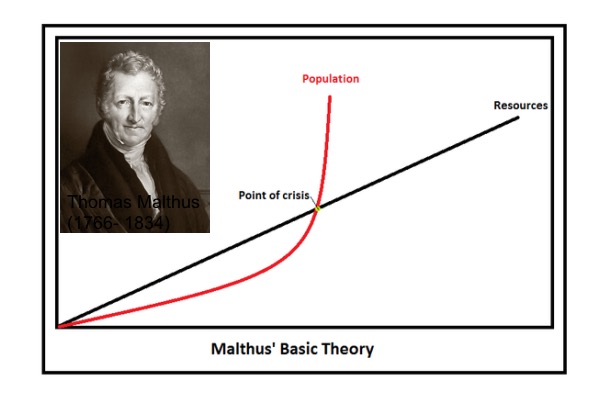
This book, Progress and Poverty details dozens of factual historic events that cut the legs out of the arguments put forth by Malthus, who has perhaps single-handedly created more obfuscation and ongoing strife than any other "scientist" of the nineteenth century. Malthus On
          Population 
His theories have justified the entrenched beliefs that population will always outpace availability of resources and that any technological advance will be unable to provide increased quality of life because our numbers will increase exponentially, outpacing the ability of the environment to support us. Now you might say, "It is true! I have seen this effect with my own eyes." however what we are all seeing is the diametric opposite. Population frequently follows a different curve. Many young people from around the planet are not choosing to have children. Even though technologies are being developed that greatly increase both the ability of our species to do more with less and the quality of life we can experience with less cost to the environment.

Just as Darwin, who read Malthus in 1838, did not understand that he was lucky, not "fit", Malthus did not understand the root causes of his privilege either. Wealth cannot fathom itself. Those on top of the pile can never experience or have empathy for the individuals upon whose suffering their exulted view is made possible. This book, by George, refutes this pedantic theory at its core. We have living proof of the opposite, yet if we talk to our friends and neighbors, how many of them will say such ridiculous things as, "The poor have brought on their own plight by making immoral choices." or that "Welfare whores steal from others by making us pay higher taxes." or "Single mothers should have kept their legs together and I should not be made to pay fort hem to raise children that are a result of their own depravity and lust." I only know that people say these things, feeling justified in doing so because I have heard self righteous, often religiously motivated people say them. Often, these lies are allowed to pass, unquestioned even though many of the most moral people i have ever met were on the poor end of the socio-economic scale. Poverty is no more brought about by poor choices than wealth accrues to those who work hard.

The Malthusian theory was just another way of trying to prop up the Divine Right of Kings, so too Darwin tried to link evolutionary survival with fitness. The wealthy never were part of the same game that the rest of us were, but they set the rules of the game, the definitions of the terms that are "agreed to" in public discussions and proffered unsupported ideas that would contaminate our minds for centuries. When the book, Progress and Poverty was read by millions, it changed the course of economics and politics. We need the information contained in it more now than ever and if you have not gotten a chance to be exposed to this well-researched and timely material, get it, read it and understand that someone over a century ago took many years to research and put it together for others, not for the enrichment of himself. It was not written to start a political dynasty, or to placate a wicked man's conscience, as so many books find their way to market today but to enlighten others about the way the world has worked for millennea.